
Concentric and eccentric reducers: selection and installation
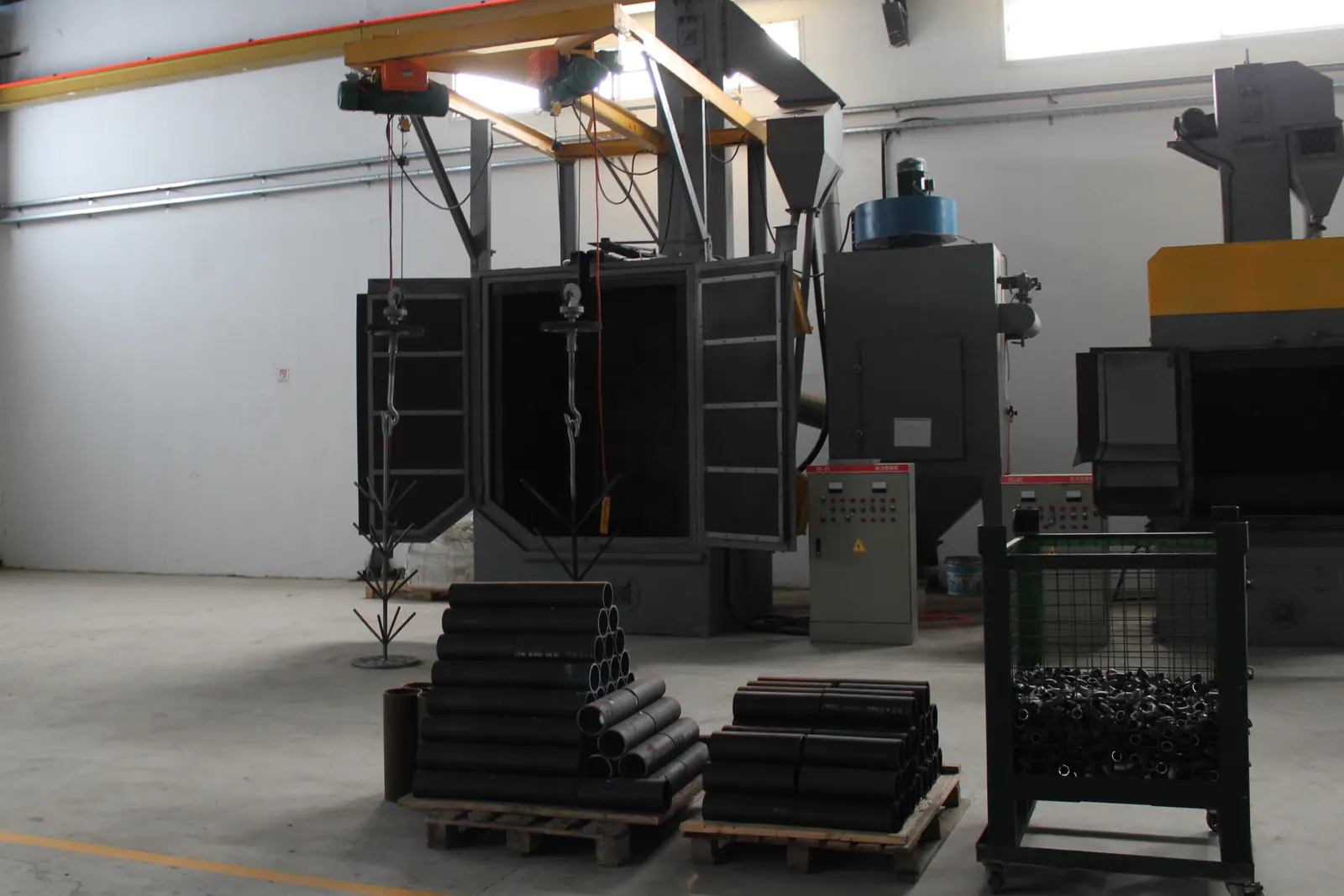
Both reducers make the same change of size. The difference shows on horizontal lines and on pump suctions, where an air pocket or deposits cause trouble.
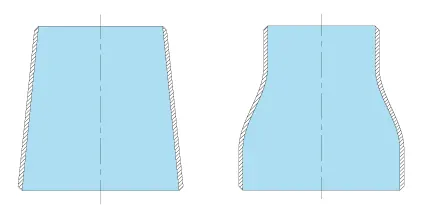
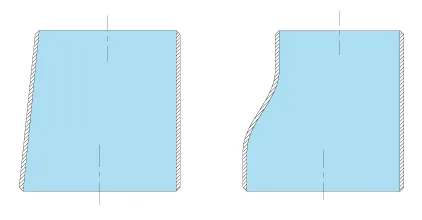
Two geometries for the same change of size
A concentric reducer keeps both pipes on one axis: it is a regular cone. An eccentric reducer offsets the axes so that one side stays straight; the whole change of diameter happens on the other side. That flat side decides its use and the way it is installed.
Where concentric reducers go
- Vertical lines, where air and deposits do not collect.
- Pump discharges, downstream of the outlet flange.
- Size changes on headers and lines where the axis position does not matter.
Where eccentric reducers go
On a horizontal line, a concentric reducer creates a high point where air gets trapped, or a low point where deposits collect. An eccentric reducer removes one or the other, depending on how it is installed.
| Installed | Effect | Typical use |
|---|---|---|
| Flat side up | No high point: air does not collect | Pump suction |
| Flat side down | No low point: the line drains | Lines to purge, slurries, racks with level pipe bottoms |
On a pump suction, an air pocket lowers the flow and can trigger cavitation, which wears the impeller. That is why suction piping design rules call for an eccentric reducer, flat side up.
What the standards say
Under ASME B16.9, a reducer’s end-to-end length H depends only on the large end; it is the same for concentric and eccentric reducers.
| Large end NPS | OD (mm) | Length H (mm) |
|---|---|---|
| 1" | 33.4 | 51 |
| 1¼" | 42.2 | 51 |
| 1½" | 48.3 | 64 |
| 2" | 60.3 | 76 |
| 2½" | 73.0 | 89 |
| 3" | 88.9 | 89 |
| 4" | 114.3 | 102 |
| 5" | 141.3 | 127 |
| 6" | 168.3 | 140 |
| 8" | 219.1 | 152 |
Concentric and eccentric reducers to ASME B16.9; tolerance on H ± 2 mm.
EN 10253-1 defines two concentric reducers: Form 1, a plain cone whose length varies with the size step, and Form 2, with rounded transitions and the same length as the eccentric reducer (see the dimension chart). We make both forms in S235, black or galvanized, and ASME concentric and eccentric reducers in A234 WPB.
Specifying a reducer
Large end first, then small end, each with its diameter and wall: 114.3 × 3.6 – 76.1 × 2.9. Add the type (concentric Form 1 or 2, eccentric), the standard, the grade and the finish. In ASME terms, for example, 4" × 3" STD A234 WPB.
A DN 100 × DN 65 reducer does not have the same small end in both series: 76.1 mm in EN, 73.0 mm in ASME. The outside diameter must be on the order.
Installation and ordering mistakes
- Installing a suction eccentric reducer flat side down: the air pocket is back.
- Swapping large and small ends on the order.
- Leaving out Form 1 or 2 on an EN reducer, although the length changes.
Standards and references
- ASME B16.9: concentric and eccentric reducers, lengths and tolerances.
- EN 10253-1: concentric reducers Form 1 and Form 2.
Frequently asked questions
Which way up does an eccentric reducer go on a suction?
Flat side up, so that air cannot collect ahead of the pump.
Can a concentric reducer go on a horizontal line?
Yes if the line carries no gas or deposits and does not need draining.
Do concentric and eccentric reducers have the same length?
Under ASME B16.9, yes, for the same large end.
Do you make EN 10253-1 eccentric reducers?
Our standard eccentric references are ASME B16.9; other versions can be made to drawing.
Read next
 Butt-weld elbows: radii, 1.5D and 3D designations, dimensions and selectionRadius designations in ASME and EN, centre-to-end dimensions, manufacturing on video and selection.
 DN to inch, NPS and outside diameter: pipe and fitting size chartDN / NPS / OD chart for the EN and ASME series, and the five sizes where they differ.
 Butt-weld fitting wall thickness: schedules, STD, XS and millimetresSTD / XS / Sch 40 / Sch 80 chart from ½" to 12", EN 10253-1 walls and what to do when walls differ.